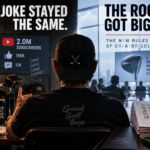
Good Good didn’t publish a domestic-violence PSA. They published a horror-parody that looked like one in the first 15 seconds — and then found out the difference between a YouTube audience and a public company’s brand-safety team.
That is the whole episode, if you refuse to flatten it.
What Actually Happened
On August 21, Good Good posted a promo for a co-branded Callaway Quantum driver. The concept, they later said, was a spoof of the horror film Obsession: the club is so coveted it turns people dangerous. What most of the internet saw was the opening cut. Garrett Clark runs in, shoves Alexis Miestowski as she reaches for the driver, stands over her, and says, “Do not touch my new driver.” The rest of the minute barely existed. The still did.
I would not have let that bit out the door. You do not need a seminar to know a man knocking a woman down from behind, then looming over her with a threat, is a loaded image. Intent is not the product. The product is what lands in the feed, stripped of the director’s note.
That is not the same thing as saying Good Good announced a position on violence against women. They didn’t. Miestowski is a colleague in a sketch. Treating a bad joke as a manifesto is a category error. A lot of the reaction did that anyway. Both of those things can be true at once.
Callaway approved the spot before it posted. Then, after the pile-on, Callaway cut the partnership, pledged $1 million to organizations working against violence against women, and said its review process wasn’t comprehensive enough. Good Good lost the Callaway deal, stepped off title sponsorship of a reported $6 million PGA Tour fall event in Austin, watched Dick’s and Golf Galaxy pull merch, and saw Golf Channel’s Big Break x Good Good reboot postponed — then cancelled outright, not just delayed.
Creator Reach Is Durable
Two million subscribers did not materialize because of Callaway, and they will not vanish because Callaway left. Fans forgive bits. They have been watching these guys be these guys for years. That following is why a public company hired them in the first place.
Creator Taste Is Probably Not a Brand Strategy
The house style that built the channel — escalate the bit, post it, delete it if it flops — does not survive a co-branded driver, a Tour title, and a box on a Dick’s shelf. Those rooms have lawyers, brand committees, and a different definition of “funny.” Good Good was still living in the small ecosystem after it had already entered the large one.
The Two-Step
The harsh part is not that people disliked the ad. The harsh part is the two-step. Callaway greenlit the file, then used Good Good as the stain that could be amputated. That is predictable corporate crisis math. It is also a signal every creator should read twice. When you leave the sandbox, your partner will not die on your hill. They will write a check to a cause and change the approval flowchart.
PGA Tour commissioner Brian Rolapp put a finer point on it, calling Good Good’s initial response “disappointing… defensive and late.” That’s not a golf-media problem. That’s a Tour partner grading a vendor’s crisis management in public.
The Kendrick Wrinkle
Here’s the part that actually proves the thesis. CEO and co-founder Matt Kendrick didn’t just get swept out by the original backlash — he went viral criticizing Callaway’s handling of the split, days after a newly hired president had barely settled into the job. Both were gone within the week.
That’s not fallout from one bad ad. That’s an executive trying to fight a brand-side consequence with a creator-side instinct — post the raw take, let the internet sort it out — and it cost him the company. The instinct that built Good Good’s audience is the same instinct that just emptied its leadership.
Two Scorecards
Was this a blemish on the creator economy? A scar, not a funeral. Brands will keep chasing young golf reach. They will also add kill-switches. Hiring young people is not the risk. Giving them a launch, a Tour event, and no one in the room willing to say “we’re not doing the shove” is the risk.
Are you only as good as your last ad? For partners, yes. For fans, no. One miss ended a chapter with Callaway and the Tour. It did not erase the audience that made those deals possible. There are two scorecards now. Creators who only watch the subscriber count will keep getting surprised.
Trust is the real cost. The next OEM that asks a creator shop to “make it feel native” will lawyer the cut. That is less funny. It is also how you stop a 15-second forearm from becoming an executive clean-out.
Growing up in public is the job now. The bit that slaps on a Wednesday vlog can end a title sponsorship on a Friday — and end a CEO’s tenure the week after that. That is not a morality play about golf bros. That is what happens when the joke stays the same and the room gets bigger.